Should You Buy the Mcafee Plus in 2026? A Deep Dive
I didn’t plan to spend several months “living with” an antivirus suite in 2026—but after a couple of sketchy download moments, a suspicious browser pop-up that wouldn’t quit, and one too many “Is this laptop getting slower or am I imagining it?” conversations with myself, I decided to get serious about endpoint protection on my everyday laptop. I bought McAfee Plus, installed it on my main Windows laptop, and kept it running through real life: work calls, travel Wi‑Fi, online shopping, occasional gaming, and the kind of messy browser tab habits I’m not proud of.
This article is my honest deep dive into what it’s like to use McAfee Plus in 2026—what I genuinely appreciated, what annoyed me, what felt “worth it,” and what I’d do differently if I were buying again. I’m writing this specifically from a laptops perspective: performance impact, usability on portable devices, battery life considerations, and whether it plays nicely with a typical laptop workflow.
My Setup and How I Tested McAfee Plus
For context, I used McAfee Plus primarily on a Windows laptop (my daily driver), and I also tried it on at least one additional device during the subscription period. My laptop usage pattern is pretty standard for 2026: lots of browser work, password-heavy logins, cloud sync, video meetings, and frequent use of public networks at airports and coffee shops.
What I paid attention to over months of use:
- Installation and onboarding: how quickly I could get protected and whether it was confusing.
- Day-to-day performance: boot time, fan noise, random slowdowns, and battery impact.
- Web protection: how it handled sketchy links, downloads, and phishing-ish pages.
- Noise level: alerts, upsells, and how often it interrupted me.
- Extra tools: any “Plus” features beyond basic antivirus that I actually used.
- Reliability: did it quietly do its job, or did it break things?
I’ll be transparent: I’m not running a lab. I didn’t feed it a curated zoo of malware samples. This is a “real owner” review—how it feels to run on a laptop you depend on every day.
What McAfee Plus Is (in Practical Terms)
McAfee Plus is positioned as more than just antivirus. In my experience, it’s a bundle: malware protection plus a set of security and privacy features that try to cover the biggest risks for regular laptop users—unsafe browsing, credential leaks, identity/privacy monitoring tools (depending on plan), and device-level protection.
When I think about the value of suites like this in 2026, I don’t ask “Does it block viruses?”—I ask:
- Does it reduce the chance I’ll get tricked by a fake login page when I’m tired and rushing?
- Does it catch bad downloads before I double-click them?
- Does it keep my laptop feeling snappy, or does it slowly turn it into a sluggish brick?
- Does it behave like a helpful security tool—or like a noisy app that wants constant attention?
Those questions ended up being the real test.
Installation and First Impressions
Getting McAfee Plus installed was straightforward. I expected the usual “security suite” friction—multiple restarts, confusing prompts, or a dozen permissions dialogs—but the setup felt fairly modern. I was up and running quickly, and the dashboard was easy enough to navigate without reading documentation.
That said, one thing I noticed early: McAfee wants to be involved. It isn’t a minimal, set-it-and-forget-it utility hiding in the system tray. The interface is built to keep you aware of “status,” and that can be reassuring… or slightly exhausting, depending on your personality.
In the first week, I spent time clicking through the sections just to understand what was included and what wasn’t. Some features felt immediately useful; others felt like “nice-to-have but not vital.”
Everyday Use on a Laptop: Performance, Battery, and Annoyances
Performance Impact (The Thing I Cared About Most)
I was genuinely worried about performance. Laptops are sensitive: you notice background CPU spikes faster than on a desktop, and fan noise is much harder to ignore when the machine is on your lap or a small café table.
After a few months, my honest take is: McAfee Plus was mostly fine day to day, with a couple of “why is this happening right now?” moments.
Looking for the best Laptops & Computers deals on Amazon?
Shop Amazon →What I found was that the laptop stayed responsive during normal browsing and office work. I didn’t feel constant drag. But I did notice occasional performance dips during heavier background activity—especially when scans or updates lined up with moments I needed the system to be quiet and smooth (like a video call or when I had 30 tabs open and was juggling large downloads).
The best way I can describe it: most of the time, I forgot it was there. But when I remembered it was there, it was usually because the fan spun up or the system got momentarily sluggish.
Battery Life
Battery life impact was subtle—not a dramatic “I lost two hours.” Still, I noticed that on days where I was already pushing the laptop hard (lots of browser tabs, streaming, syncing, and background apps), the battery felt like it drained a bit faster. It wasn’t enough to make me uninstall, but it did reinforce a laptop-specific truth: every background service matters.
If you’re on an ultrabook and you care about squeezing every minute out of your battery, any full suite deserves scrutiny. For me, the trade-off felt acceptable, but not invisible.
Notifications and “Noise”
One thing that bothered me: the suite sometimes felt like it was trying to do two jobs—security and marketing. I’m okay with occasional reminders, but I don’t want my security product to behave like a chatty assistant that constantly wants validation.
Over time, I tuned out most of it. But if you’re the kind of person who hates extra prompts, I’d put this in the “consider carefully” category.
Protection Experience: Web, Downloads, and Real-World Threats
Browsing and Phishing Protection
My biggest practical risk isn’t some movie-style virus—it’s getting phished when I’m multitasking. That’s where I wanted McAfee Plus to earn its keep.
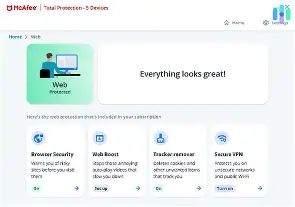
In my experience, the web protection layer was one of the more valuable parts of the bundle. It gave me an extra “are you sure?” moment when I clicked links that felt borderline. I wouldn’t claim it saved me from disaster every week, but I appreciated that it added friction in the exact places where humans make mistakes: rushed logins, unfamiliar sites, and random redirects.
I was surprised by how much I liked having an additional filter beyond the browser’s built-in safeguards. Modern browsers are better than they used to be, but I still found it comforting to have another opinion—especially on public Wi‑Fi.
Downloads and File Scans
I download a lot of small utilities, drivers, PDFs, and the occasional “this should be safe” file from forums or third-party sources (I know, I know). McAfee Plus handled routine scanning quietly, and I didn’t feel like it was blocking legitimate downloads constantly.
The flipside: when it did slow down around download time, it was noticeable. If you’re doing lots of big transfers or installing large apps frequently, those little delays can add up emotionally, even if they’re not huge in seconds.
False Positives and App Conflicts
I didn’t run into dramatic false positives that broke my workflow, but I did have a couple of “wait, why is this being flagged?” moments with lesser-known installers. Those situations weren’t catastrophic—more like an extra step where I had to verify what I was installing and decide whether to proceed.
Discover deals on Laptops & Computers — updated daily.
See Deals →To be fair, that’s not always a bad thing. Security software being slightly paranoid can be annoying, but it’s also kind of the point. Still, I prefer when these tools explain clearly why they’re concerned. When the reasoning is vague, it’s harder to make a confident decision.
The “Plus” Features: What I Actually Used vs. What I Ignored
With security suites, I always end up using a few core functions and ignoring the rest. McAfee Plus was similar.
Features I Found Genuinely Helpful
- Real-time protection: the baseline value. I liked knowing it was running without me having to think about it daily.
- Web safety checks: I got practical value from this more than I expected.
- Device status/dashboard: when I wanted reassurance (or when something felt off), it was easy to check.
Features That Felt Optional (For Me)
- Extra “optimization” style tools: I’m cautious with any feature that claims to speed up my laptop with one click. I prefer to manage startup apps and storage myself.
- Privacy extras I didn’t need daily: these can be valuable depending on your lifestyle, but I didn’t interact with them constantly.
- Anything that felt like a separate product inside the suite: when a bundle becomes a mini ecosystem, I tend to stick to the essentials.
If you’re buying McAfee Plus for the add-on tools, I’d recommend checking whether you’ll truly use them. In my case, the core protection and web layer were the star, and everything else was secondary.
Pros and Cons (After Months of Real Use)
Pros
- Solid everyday protection without constant hands-on management once I got past the initial setup.
- Web protection was legitimately useful for reducing risky clicks and adding a second layer beyond the browser.
- Interface was understandable—I didn’t feel lost finding basic settings and status.
- Mostly light day-to-day footprint for typical laptop tasks like browsing and office work.
Cons
- Occasional performance “moments” where scans/updates lined up with bad timing (calls, heavy multitasking).
- Notification/upsell vibe at times—less “quiet guardian,” more “suite that wants attention.”
- Some features felt like filler unless you’re the kind of user who likes bundled utilities.
- Not invisible on battery-sensitive laptops—the impact was not extreme, but not zero.
Comparison Table: McAfee Plus vs. Typical Alternatives (How It Felt in Use)
I’m not going to pretend I ran a lab-grade benchmark against every competitor. But I have used other approaches over the years—built-in OS protection alone, lightweight antivirus tools, and full “security suite” packages. Here’s the most honest comparison I can give based on lived experience on a laptop.
| Option | Protection Feel | Laptop Performance Feel | Noise Level | Best For |
|---|---|---|---|---|
| McAfee Plus | Strong “covered” feeling; good web safety layer | Mostly smooth, with occasional slow moments during scans/updates | Medium (some prompts and promotional-feeling nudges) | People who want a broad bundle and extra web protection beyond the browser |
| Built-in OS protection only | Decent baseline, but less guided help for risky browsing habits | Usually the lightest footprint | Low | Careful users who keep systems updated and avoid sketchy downloads |
| Lightweight antivirus (minimal suite) | Good file protection; web features vary | Often lighter than full suites | Low to medium | People who mainly want malware scanning without extra bundled tools |
| Another full security suite | Often comparable; differences come down to UX and extras | Varies; suites can be heavier on older laptops | Medium to high | People who like “one subscription covers everything” ecosystems |
If your laptop is older or already running hot, I’d pay extra attention to that “performance feel” column. Suites tend to be the first thing you blame when the fan gets loud—and sometimes that blame is justified.
Buying Guide: Should You Buy McAfee Plus in 2026?
After living with it, I don’t think McAfee Plus is a universal yes or no. It depends on what kind of laptop user you are and what problems you’re trying to solve.
Buy McAfee Plus in 2026 if you’re this kind of laptop user
- You use public Wi‑Fi often and you want extra layers around browsing and risky links.
- You manage a lot of accounts (shopping, banking, work tools, subscriptions) and want more reassurance while navigating logins.
- You download installers and utilities from a variety of sources and want active scanning watching your back.
- You prefer an all-in-one dashboard instead of piecing together separate security tools.
Skip it (or consider a lighter option) if you’re this kind of laptop user
- Your laptop is performance constrained (older CPU, limited RAM, already slow). Even small overhead can feel big.
- You hate prompts and want security that stays quiet unless something is truly urgent.
- You’re already disciplined about updates, safe browsing, and you mostly stick to reputable app sources.
What to Look for Before You Commit
If you’re deciding in 2026, here’s what I’d personally check before choosing McAfee Plus (or any suite) for a laptop:
- Device count and cross-device coverage: I always regret buying a plan that doesn’t match how many devices I actually use.
- Web protection behavior: I’d rather have smart link protection than a dozen “cleanup” utilities.
- Notification controls: the ability to quiet non-essential alerts matters a lot over months.
- Scan scheduling: I want scans to run when I’m away, not during my busiest hours.
- Uninstall cleanliness: this is underrated. If I don’t like it, I want to leave without a fight.
My Practical Tips for Using It on a Laptop
If you do buy McAfee Plus, here are the adjustments that made my experience better:
- Schedule scans for off-hours when the laptop is plugged in. This reduced those “bad timing” slowdowns.
- Trim non-essential notifications so security stays informative rather than distracting.
- Pay attention to startup impact. If you notice slower boot times, look at what’s launching at login and adjust.
- Keep your browser updated anyway. No suite replaces basic hygiene.
So, Should You Buy McAfee Plus in 2026? My Verdict
After testing McAfee Plus for several months on my laptop, I’d describe it as a capable, generally trustworthy security companion that sometimes tries a little too hard to be a “suite.” I appreciated the day-to-day protection and especially liked the extra layer around web browsing—because that’s where I see the most real-world risk for normal laptop users.
At the same time, I can’t pretend it was perfectly invisible. I noticed occasional performance dips at inconvenient moments, and I didn’t love the times it felt more talkative than necessary. If you’re extremely sensitive to background overhead or you want a minimalist experience, you might be happier with a lighter approach.
But if you’re the kind of person who knows you’ll occasionally click something questionable, use public networks, and generally live a modern online life with too many accounts and not enough patience for risk, McAfee Plus in 2026 is a reasonable buy—especially if you take a few minutes to tune it so it behaves like a quiet guardian rather than a constant commentator.